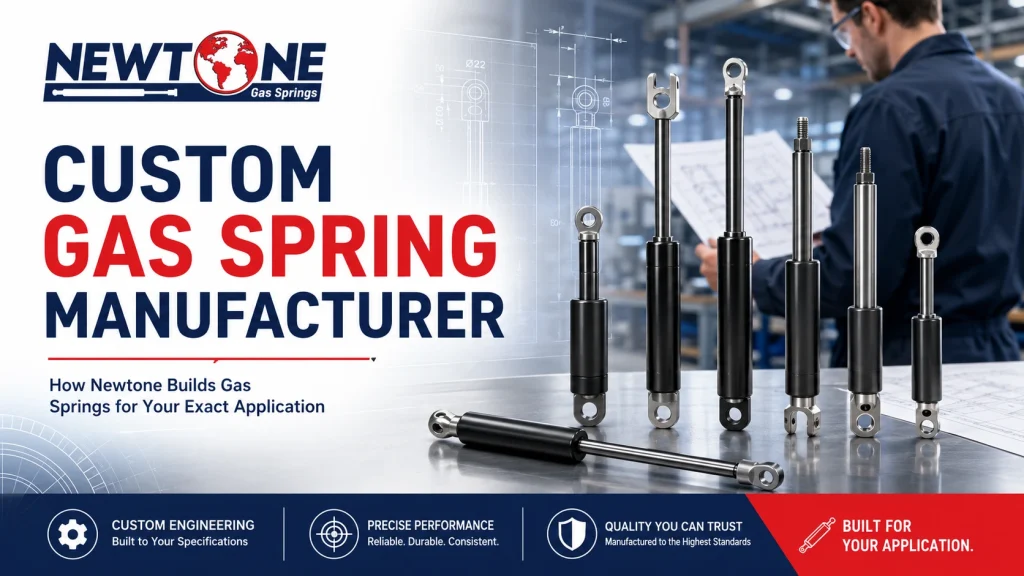
Manufacturer
How Newtone builds gas springs to your exact force, stroke, material, and fitting requirements — from raw stock to a tested, batch-traceable part.
What a Custom Gas Spring Manufacturer Actually Builds, Piece by Piece
A custom gas spring manufacturer builds a part to your exact force, stroke, material, and fitting requirements — not the nearest catalogue size — by controlling every step from raw tube and rod stock through machining, rod treatment, filling, and testing in its own facility. That distinction matters more than it sounds: a distributor can offer you options, but only a manufacturer can change the thing itself when your application needs a diameter, a treatment, or a fill pressure nobody stocks.
We wrote our specification checklist — how to specify a custom gas strut — for engineers who already know they need a custom part and want the brief right. This page answers a different question: what does “custom manufacturer” actually mean once the order lands on our floor, and where does that manufacturing capability genuinely help versus where it doesn’t. At Newtone Gas Springs, we’ve been building custom gas springs for OEM and industrial customers across 60+ countries for over two decades, and we’d rather show you the process than just claim the word “custom.”
Who this is for: Procurement teams evaluating manufacturing partners rather than catalogue suppliers, OEM engineers who want to understand what’s actually adjustable in production, and buyers deciding whether a project needs a true custom build or a configurable standard part.
Why Force Is a Manufacturing Decision, Not a Catalogue Choice
Gas spring force comes directly from internal pressure acting on the rod’s cross-sectional area — which means the two manufacturing variables that actually set force are the fill pressure and the rod diameter, and a real manufacturer can adjust either.
Force From Pressure and Rod Area
F = ΔP × A, where A = π × d² ÷ 4
ΔP = internal pressure differential • A = rod cross-sectional area • d = rod diameter
Worked example — two rod diameters at the same internal pressure of 12 bar (174 psi):
An 8 mm (0.31 in) rod: A = π × 8² ÷ 4 = 50.3 mm² → F ≈ 60 N (13 lbf).
A 16 mm (0.63 in) rod — double the diameter — at the same pressure: A = π × 16² ÷ 4 = 201 mm² → F ≈ 241 N (54 lbf), roughly four times the force, because area scales with the square of the diameter.
This is why a manufacturer with in-house rod machining can hit an exact force target by choosing the right diameter and fill pressure together, rather than over-pressurizing a standard-diameter part to force it into a spec it wasn’t built for — a shortcut that shows up later as a spring that feels harsh at one end of the stroke.
Inside the Production Process
“Custom” is a real production sequence, not a checkbox. Here’s what changes at each stage, and why it matters for your specific application.
Rod & Body Machining
Diameter, stroke length, and body wall thickness are cut to the calculated spec, not selected from a fixed size chart. This is what lets a force target and a packaging constraint both be met at once.
Rod Surface Treatment
Black-nitrided finish at 900–1,000 HV (20–30 µm) as standard, or 304/316L stainless for corrosion-critical environments — chosen for the operating environment, not applied uniformly.
Seal & Oil Selection
HNBR seals as standard for UV and ozone resistance, with standard, food-grade, high-temperature, or low-temperature oil selected against the −40°C to +100°C (−40°F to +212°F) operating range.
Fill Pressure & Testing
Each spring is charged to the calculated pressure for its target force, then tested to the ±5% tolerance before it’s approved for the batch — not sampled after the fact.
We had an OEM customer send us dimensions for a new access-panel platform before tooling had even been finalized. Their initial force estimate — a reasonable guess based on panel weight alone — turned out to be roughly 30% higher than the moment-balance calculation showed once we factored in their actual hinge offset and mounting angle. Building to the corrected figure instead of the initial guess meant the panel opened and held correctly on the first production sample, rather than needing a second tooling run after field complaints. That’s the value of catching the number before the part is built, not after.
The Product Range a Full Custom Manufacturer Builds Across
| Product Family | Typical Use Case | Custom Variables |
|---|---|---|
| Standard compression | Lids, hatches, access panels | Force, stroke, diameter, fittings |
| Locking | Service access, safety hold-open | Release mechanism, lock position |
| Traction (pull-type) | Retractable panels, return-assist | Force direction, stroke, mounting |
| Double-stroke / double-action | Multi-position furniture, complex lifts | Stage forces, transition points |
| Side / end valve, force-adjustable | Prototyping, field-tunable force | Adjustable range, bleed-down method |
| Friction & multiforce springs | Ergonomic furniture, positioning | Friction level, force curve |
| Non-gas mechanical springs | Cost-sensitive or leak-averse applications | Spring rate, travel |
Where This Manufacturing Capability Doesn’t Extend
Being a manufacturer with broad custom range doesn’t mean unlimited scope, and we’d rather say that directly than let a procurement team assume it. Newtone does not hold AS9100, NADCAP, ISO 13485, FDA, or ITAR/MIL-SPEC certification. Our gas springs are a strong fit for non-flight-critical, experimental, and ground-support aviation applications, general industrial equipment, and commercial housings — not for flight-critical airframe components or implantable medical devices, which require certified hardware to a program’s approved specification. If your application sits in that certified space, we’ll tell you so before quoting, rather than after.
Why Source Custom Gas Springs from Newtone
Manufacturing control means we can change the part itself — not just pick from what’s already on the shelf.
Frequently Asked Questions
Every gas spring is built in Newtone’s own facility in Turkey, from raw tube and rod stock through machining, rod treatment, filling, and testing. A distributor resells parts built to someone else’s tolerances; a manufacturer controls force tolerance, material sourcing, and lead time directly, which is what makes true per-order customization possible rather than picking the nearest catalogue size.
Force equals internal pressure multiplied by rod cross-sectional area, and area scales with the square of the diameter. Doubling the rod diameter roughly quadruples the force delivered at the same internal pressure, which is why a manufacturer with in-house rod machining can hit an exact force target without over-pressurizing a standard-diameter part.
Newtone does not hold AS9100, NADCAP, ISO 13485, FDA, or ITAR/MIL-SPEC certification. Newtone’s gas springs are well suited to non-flight-critical, experimental, ground-support, and general industrial or equipment-housing applications, but a flight-critical or implantable medical component requires certified hardware from a qualified source, and we say so plainly rather than overselling scope.
Force (or the weight and mounting geometry to calculate it), stroke, extended length, rod and body diameter, end fittings for both ends, and the operating environment and temperature range. If any of those are unknown, sending a drawing, photo, or the panel weight is enough for our engineering team to fill the gap.
Force is held to a ±5% tolerance and springs for a given order are batch-traceable, so paired or high-volume production runs stay matched to each other rather than drifting across a long build. First-article samples are reviewed against the original specification before full production releases.
Conclusion
A custom gas spring manufacturer earns that title in the machining shop and the fill station, not in a marketing line — force set by rod diameter and pressure together, material chosen for the real environment, and every unit tested to a tight, traceable tolerance. That’s the difference between a part that’s technically customizable and one that’s actually correct for your application.
Tell us the application, the environment, and what you already know about force and geometry — we’ll fill the rest, quote it, and tell you honestly if your project needs certified hardware we don’t supply.
Get Your Custom Gas Spring Specified
Share your force, stroke, environment, and any geometry you have. Our engineering team handles the calculation and returns a full specification and quote.