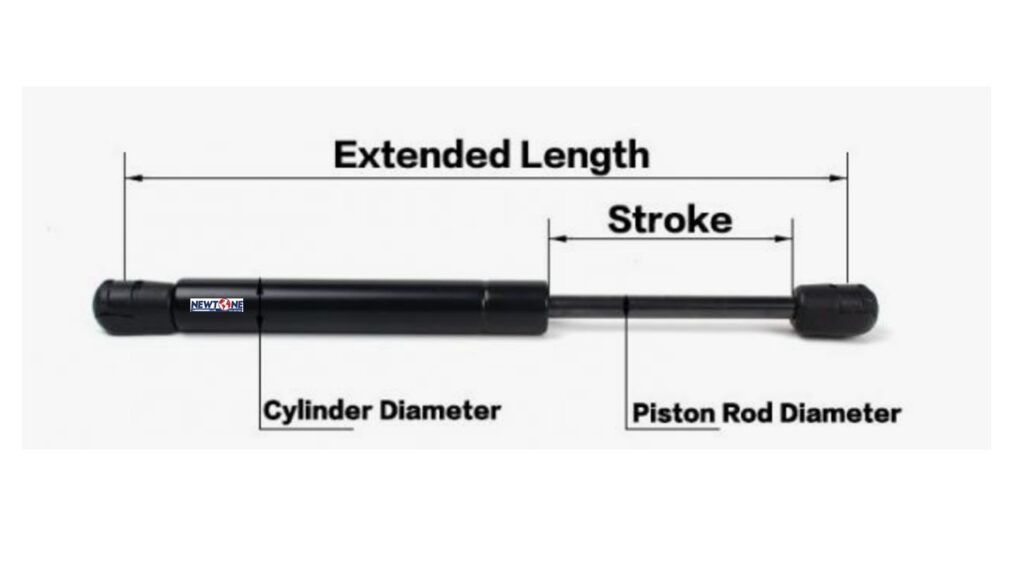
A gas strut is fully described by four numbers: extended length, compressed length, stroke, and rod/tube diameter, all measured center-to-center at the end fittings with the strut removed and fully extended. Get one of those wrong, or measure a strut while it’s still holding a panel open, and the replacement either won’t sit on the mounting points or won’t hold the load once it’s fitted.
Most people only measure a gas strut once in their life: the old one is leaking, sagging, or has stopped holding a hatch open, and a replacement is needed fast. This guide is written for that moment — whether you’re an OEM engineer specifying a part for a new platform, a distributor matching stock to a customer’s photo, or someone standing next to a boat hatch with a tape measure. The steps are the same either way; only the tools change.
How to Measure a Gas Strut: The Four Core Dimensions
Every gas strut order comes down to four figures, and they’re not interchangeable — mixing up two of them is the single most common reason a replacement arrives and doesn’t fit.
Extended length. Measure center-to-center between the two mounting points (ball stud, eyelet, or bracket hole) with the strut fully extended — its natural, at-rest position with no load pushing it closed. This is the number most catalogues list first, and it’s the one to match if you’re replacing a strut like-for-like.
Compressed length. The same center-to-center measurement with the strut fully pushed in. You’ll rarely measure this directly on an installed strut — it matters mainly for confirming the part will physically fit in the closed position without the end fittings colliding with the frame.
Stroke. The distance the rod travels between those two positions. This is a calculated value, not a separate measurement — see the formula below — and it’s what actually determines how far the panel or lid will open.
Rod and tube diameter. Measured in millimeters with calipers if you have them, or a tape measure wrapped around the circumference if you don’t (divide by 3.14 to get diameter). Rod diameter and tube (body) diameter are two different numbers and both belong in the size code — for example an 8 mm (0.31 in) rod inside an 18 mm (0.71 in) tube is written 8/18, not just “8mm.”
Stroke — the working relationship
Stroke = Extended length − Compressed length
Worked example: A hatch strut measures 500 mm (19.7 in) extended and 350 mm (13.8 in) compressed.
Stroke = 500 mm − 350 mm = 150 mm (5.9 in).
That 150 mm (5.9 in) of travel is what has to clear the hatch opening angle you need — if the specified stroke falls short, the lid stops before it reaches full open, no matter how strong the strut is.
Once stroke and geometry are confirmed, sizing the actual holding force is a separate calculation (moment about the hinge, F = (W × Lg × cos φ) ÷ (n × r)) — measurement gets you the right envelope; force calculation gets you the right lift. Our engineering team can run that number from your panel weight and pivot geometry if you’re not sure which governs.
The mistake that causes most wrong-size orders: measuring overall length including the ball studs or brackets, then comparing it to a catalogue figure that’s center-to-center. Two struts can look the same length on a tape measure and be 15–20 mm (0.6–0.8 in) apart once you account for fitting style. Always measure to the center of the pivot point, not the outer tip of the fitting.
How to Measure a Gas Strut That’s Still Installed
You can measure most of what you need without pulling the strut off, and for a heavy panel that’s often the safer option anyway. Support the panel first — prop it open with a length of timber or a second person holding it — before you touch the strut. Gas struts are pressurized; don’t clamp the rod in a vise, don’t force it past its natural stroke, and don’t disconnect the lower mount while the panel’s full weight is resting on the strut.
With the panel propped and the strut unloaded, measure center-to-center between the two pivot points exactly as described above. If the strut won’t come off the brackets easily, measure the visible rod diameter with calipers and note the fitting type (see below) — that’s usually enough for our team to identify the part from a photo and a couple of numbers, without you removing anything.
End Fittings: The Detail Every Length Chart Skips
Length and diameter get a strut in the right ballpark; the end fitting is what actually lets it bolt on. The three common types are ball socket (a cupped fitting that snaps over a ball stud, allowing angular movement), eyelet (a plain hole for a clevis pin, used where the mount rotates on a pin rather than a ball), and threaded stud (a fixed rod end that screws directly into a bracket, common on industrial and OEM assemblies). A strut with the right length and the wrong fitting still won’t mount — and because fittings are rarely called out clearly in online size charts, this is where most of our support requests actually start. If you’re unsure which type you have, a close-up photo of the fitting against a coin or ruler for scale tells us more than a written description ever does. Full bracket options are in our mounting bracket range.
We had a distributor bring us exactly this problem a while back — an aftermarket customer of theirs had an original strut off a discontinued equipment platform, no visible part number, and a paint code that matched nothing in their supplier’s catalogue. Rather than guess from the length alone, we walked through extended length, stroke, rod diameter, and fitting type on a call, matched force from the panel weight the customer described, and built a replacement from the same production line as our standard range. The part bolted straight on. The lesson that stuck with us: when the label’s gone, the four measurements plus the fitting type are almost always enough — you don’t need the original part number if you have the numbers themselves.
Why Two Struts on the Same Door Have to Match
If you’re replacing one strut out of a matched pair — a tailgate, a large lid, a machine cover with dual supports — measure it, but don’t order a single strut in isolation. A strut sold today and one from a different production batch can sit at opposite ends of the same tolerance band and still both be “in spec” individually. Fit one worn or off-batch strut alongside a fresh one and the panel lifts unevenly, twists slightly on its hinges, and puts side load on the weaker of the two — which is itself a wear accelerant, since gas struts are designed for axial load only. We build to a ±5% force tolerance and match pairs from the same production batch specifically to avoid this; if only one strut has failed, it’s worth replacing both from a matched set rather than pairing new with old.
| Measurement | What it tells you | How to get it | Common mistake |
|---|---|---|---|
| Extended length | Overall size for a like-for-like match | Center-to-center, strut fully extended | Measuring outer tip to outer tip instead of pivot to pivot |
| Compressed length | Confirms it physically fits when closed | Center-to-center, strut fully compressed | Rarely measured directly — usually calculated |
| Stroke | How far the panel will actually travel | Extended length − compressed length | Assuming stroke and extended length are the same number |
| Rod / tube diameter | Size code and force-rating range | Calipers, or tape circumference ÷ 3.14 | Recording only one diameter instead of rod and tube |
Why Source Your Replacement from the Manufacturer
Once you’ve got the four measurements and the fitting type, where the strut comes from matters almost as much as the numbers themselves. We manufacture in Turkey and export to 60+ countries, supplying the same production line to OEMs and aftermarket customers alike — so a one-off replacement is built to the identical spec as a 500-unit OEM order, not a downgraded consumer version.
Struts used near the coast or in high-humidity environments are worth a second look before you reorder the same black-rod part: salt exposure pits chrome and nitrided rods over a few seasons, which shows up first as rough travel and then as seal leaks. If that matches what you’re seeing on the strut you just measured, our stainless steel gas springs are worth specifying instead of a direct repeat order. Engineering support is available if you’d rather send us the four numbers and a photo of the fitting than work through the sizing yourself — response is typically within 5 business hours.
Frequently Asked Questions
Do I measure a gas strut extended or compressed?
What’s the difference between stroke and overall length?
Can I measure a gas strut without taking it off?
Do both struts on a double-strut application need to be identical?
There’s no part number on my old strut — what now?
Get the Right Replacement the First Time
Four measurements, one fitting type, and — if it’s a paired application — a matched set from the same batch. That’s the whole job. Skip the guesswork on any one of those and the part either doesn’t mount or doesn’t hold, and you’re back to measuring again in a week.