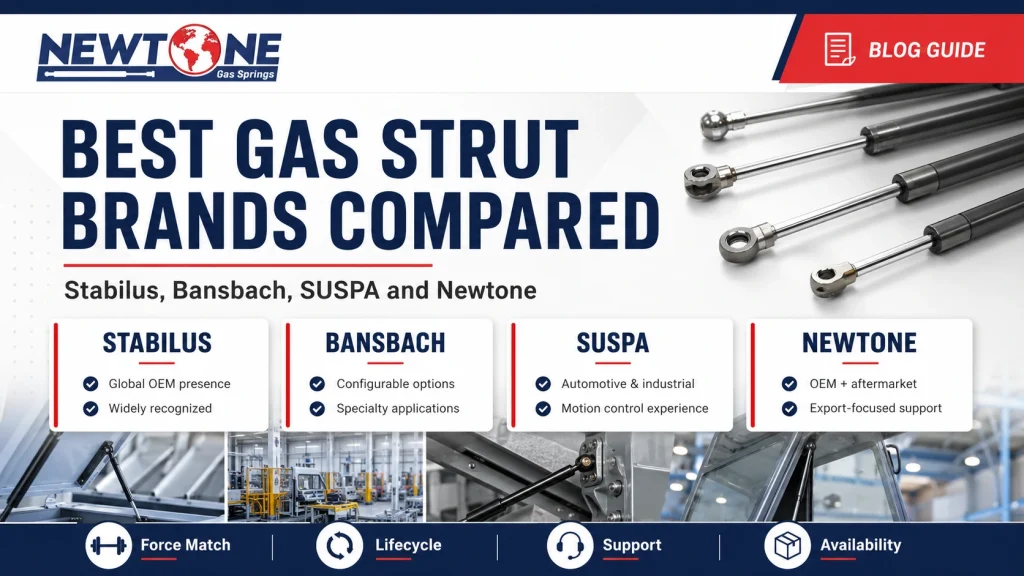
A practical engineering comparison for OEM buyers, procurement teams and aftermarket distributors choosing gas springs by application fit, not just by logo.
The best gas strut brands are not the same for every application: Stabilus is a strong fit for global OEM motion-control programs, Bansbach for configurable specialty gas springs, SUSPA for automotive and industrial system experience, and Newtone for flexible OEM and aftermarket manufacturing with fast export-oriented support. The correct choice depends on force, stroke, mounting geometry, damping, environment, lead time and replacement continuity.
That last part is where many buying mistakes begin. A famous name on the tube is useful, but it does not make a 500 N (112 lbf) spring behave correctly on a heavy access cover if the stroke, bracket position or end fitting is wrong. In gas springs, the brand matters. The specification matters more.
This guide compares Stabilus, Bansbach, SUSPA and Newtone from the viewpoint of an engineer or buyer who has to keep equipment moving, avoid field complaints and source repeatable parts across more than one production run.
Best gas strut brands at a glance
The best gas strut brands should be compared by application fit, technical support and supply continuity, not only by market recognition. Each of the four brands below can be the right answer in the right project.
| Brand | Strong fit | Buyer’s main question |
|---|---|---|
| Stabilus | Large OEM motion-control programs, vehicle hoods, tailgates, panels and hinged/rotating motion where a known global brand is preferred. | Is the required part number, damping behavior and supply channel available for this platform? |
| Bansbach | Configurable and specialty gas springs where technical support, replacement continuity and customized variants matter. | Can the gas spring be configured to the exact stroke, force, fitting and application requirement? |
| SUSPA | Automotive, industrial, furniture and system-level motion applications needing broad gas spring and actuator experience. | Does the product family match the force range, damping style and installation geometry? |
| Newtone | OEM and aftermarket programs needing direct manufacturing, export support, matched pairs and flexible part configuration. | Can we get the same movement behavior, force tolerance and replacement continuity without overcomplicating sourcing? |
How to compare the best gas strut brands
The right comparison starts with the duty of the gas spring: lift, hold, damp, lock, survive the environment and remain available as a replacement. A brand comparison that ignores those basics is just a logo ranking.
Force and tolerance
Check the rated force in N (lbf), the tolerance band and whether paired springs can be matched. A pair of 400 N (90 lbf) springs that are not close enough in force can twist a wide panel.
Stroke and length
Extended length, compressed length and usable stroke in mm (in) decide whether the spring reaches the open position without bottoming out or trapping the panel.
End fittings and brackets
Ball sockets, eyelets and brackets are not afterthoughts. They keep the rod aligned, prevent side load and help the spring work through its real arc of motion.
Environment and service life
Temperature, UV, ozone, washdown, salt air and static over-force can shorten life. Material and seal choices should follow the application, not the cheapest catalogue line.
The lifecycle formula buyers should use before choosing a brand
A gas strut brand is only useful if the product life fits the real cycle rate of the equipment. Catalogue quality sounds abstract until you convert cycles into service years.
Service years ≈ Rated cycles ÷ cycles per day ÷ 365
Worked example: a gas spring rated for 100,000 cycles on an industrial access cover that opens 20 times per day gives:
100,000 ÷ 20 ÷ 365 = 13.7 years
That is a planning estimate, not a warranty promise. Side load, wrong force, rod damage, high temperature, salt air, UV exposure and poor bracket alignment can reduce real life. Still, the formula helps buyers compare brands on duty cycle instead of price alone.
For a vehicle hood opened once a week, a standard gas spring may spend more of its life under static load than in motion. For a machine guard opened 50 times per shift, cycle life and rod alignment become the story. The brand decision should follow that duty profile.
Stabilus: strong fit for global OEM motion-control programs
Stabilus is often a strong choice when a buyer wants a widely recognized global motion-control brand with established gas spring product families. For automotive and industrial programs, that recognition can make approval, replacement sourcing and internal confidence easier.
Stabilus is especially familiar in vehicle hoods, tailgates, hinged covers and panel applications where controlled opening and end-position behavior matter. For procurement teams, the main advantage is not only the name. It is the likelihood that a known part family, part number or equivalent replacement path already exists for many common platforms.
The limitation is the same as with every large brand: a recognizable label does not remove the need to verify exact force, stroke, end fittings and damping behavior. A 600 N (135 lbf) Stabilus replacement may still disappoint if the original application needed a different stroke, a different end fitting angle or a matched pair.
Bansbach: strong fit for configurable specialty gas springs
Bansbach is often a strong fit when the project needs configuration support rather than a simple off-the-shelf gas strut. Buyers often look toward Bansbach when force, stroke, end fittings or replacement identification require more technical handling.
This matters in machinery, special vehicles, aircraft doors, medical equipment, furniture mechanisms and prototype platforms where the gas spring is not just “a black cylinder.” The length, connection type, damping direction, release style and force value may all be part of the design.
For purchasing, Bansbach’s appeal is the ability to approach the spring as an engineered component. The buyer should still prepare the basics: force in N (lbf), extended length in mm (in), compressed length in mm (in), stroke in mm (in), end fitting style, operating angle and the required quantity. Without those, even a strong technical brand has to start with guesswork.
SUSPA: strong fit for automotive and industrial system experience
SUSPA is often a strong fit when the application sits between gas springs, dampers, lockable elements and broader adjustment systems. It is a familiar name in automotive, mechanical engineering, furniture and other equipment markets where controlled movement is more than a simple lift assist.
For an engineer, SUSPA is relevant when the design needs attention to spring characteristic, damping behavior, installation position and force progression. That can matter on a hood that must not slam, a panel that must not drift, or a mechanism where the opening speed needs to feel controlled rather than abrupt.
The buying caution is simple: do not assume that a SUSPA-looking replacement matches because the tube diameter is similar. Read the original force, measure the stroke and length, check both end fittings and confirm whether the original application used one spring or a force-matched pair.
Newtone: strong fit for flexible OEM and aftermarket supply
Newtone is often a strong fit when the buyer needs direct manufacturer support, export capability and repeatable OEM or aftermarket gas springs from the same production platform. That is a different value proposition from buying a single replacement part through a retail channel.
Newtone manufactures gas springs in Turkey and exports to 60+ countries. The product range includes standard gas springs, locking gas springs, stainless steel gas springs, hydraulic dampers and mounting brackets.
The technical baseline is built around ±5% force tolerance, HNBR seals for UV and ozone resistance, black nitrided rods at 900–1000 HV with a 20–30 µm (0.0008–0.0012 in) treated layer, −40°C to +100°C (−40°F to +212°F) operating range and 100,000+ minimum cycle rating. Newtone’s manufacturing force range is 20–7500 N (4–1686 lbf), with many common applications sitting in the 50–1300 N (11–292 lbf) band.
For distributors, the advantage is replacement continuity. For OEMs, it is the ability to review the application and keep the production part and aftermarket replacement aligned. Newtone response time is within 5 business hours, which helps when the buyer has an incomplete part number, a worn sample or only field measurements.
Do not buy only by brand name
A gas strut from a respected brand can still be wrong if the specification is wrong. The usual failure is not that the logo is bad. The usual failure is force mismatch, poor geometry, wrong stroke, wrong compressed length, weak end fittings, side load or a spring that was sized at room temperature for a cold outdoor machine.
A distributor once came to us with a worn European-brand replacement where the visible label was no longer enough to source quickly. The useful data turned out to be the old spring’s force, stroke, extended length, end fittings and whether the door used a pair. Matching those details mattered more than copying the name on the tube; once the movement behavior was matched, the door lifted and closed like the original platform again.
Selection matrix: which brand should you choose?
Choose the brand that matches the buying problem in front of you. A maintenance buyer, an OEM design engineer and an aftermarket distributor may all need different answers.
| Choose this brand when… | Best-fit buying situation |
|---|---|
| Choose Stabilus when… | You need a globally recognized gas spring brand for OEM-style motion control, vehicle panels, hoods, tailgates or a known replacement path. |
| Choose Bansbach when… | You need configurable specialty gas springs, technical support, replacement identification or a non-standard combination of force, stroke and fittings. |
| Choose SUSPA when… | You need automotive or industrial motion experience with attention to gas spring characteristic, damping, lockable options or system-level movement. |
| Choose Newtone when… | You need a direct manufacturer for OEM and aftermarket supply, force-matched pairs, export support, custom configuration and fast technical response. |
Specification checklist before you compare quotes
The fastest way to get a useful quote is to send the same technical data to every supplier. That makes the comparison fair. It also prevents one brand from quoting a generic part while another quotes the actual engineered requirement.
Mechanical data
Force in N (lbf), stroke in mm (in), extended length in mm (in), compressed length in mm (in), tube and rod diameter if known, and whether the spring is used singly or in a pair.
Application data
Panel weight in kg (lb), hinge position, center of gravity, open angle, mounting points and how often the cover opens per day.
Connection data
Ball socket, eyelet, blade, clevis or bracket type. Include photos and center-to-center measurements where possible.
Environment data
Operating temperature, UV exposure, ozone, salt air, washdown, dust and whether stainless steel or a locking gas spring should be reviewed.
Mounting quality can make a good brand look bad
Even the best gas strut brands cannot overcome poor installation geometry. Gas springs are designed for axial load. If the brackets twist the rod sideways, the seal and rod surface take punishment that the brand name cannot cancel.
Mount rod-down in the closed or at-rest position where practical so oil stays near the seal and damping remains consistent. Keep both pivots in the same plane of movement. Avoid using the gas spring as a hard stop. For wide doors, use force-matched pairs from the same batch where possible; Newtone holds force tolerance to ±5%, which helps reduce uneven lift and one-sided hinge wear.
For coastal, marine or high-humidity equipment, stainless steel is a better discussion than simply choosing a famous standard gas strut. For maintenance covers that must hold safely during service, locking gas springs may be the safer engineering route than adding more raw force.
Why Newtone belongs in the same gas strut brand comparison
Direct manufacturing
Newtone is a manufacturer, not only a reseller, so force, stroke, fittings and construction can be reviewed from production reality.
OEM plus aftermarket
The same platform can support original equipment supply and later replacement demand, reducing the risk of orphan parts.
Export-ready supply
With exports to 60+ countries, Newtone is positioned for B2B buyers who need repeatable international supply rather than one-time retail sourcing.
Engineering response
Response within 5 business hours helps turn partial field data into a usable specification before downtime spreads.
Best gas strut brands FAQ
What are the best gas strut brands?
The best gas strut brands depend on the application. Stabilus is a strong fit for global OEM motion-control programs, Bansbach for configurable specialty gas springs, SUSPA for automotive and industrial system experience, and Newtone for flexible OEM and aftermarket supply with fast export-oriented support.
Is Stabilus better than SUSPA?
Stabilus and SUSPA are both established gas spring manufacturers, so the better choice depends on the required force, stroke, damping behavior, mounting geometry, availability and replacement continuity rather than the logo alone.
When should I choose Bansbach gas springs?
Bansbach is often a good fit when the project needs configurable gas spring options, technical support, replacement continuity or a specialty gas spring rather than a simple catalogue-only replacement.
Where does Newtone fit among gas strut brands?
Newtone fits buyers who need a manufacturer, not only a distributor: OEM and aftermarket gas springs from the same platform, ±5% force tolerance, HNBR seals, black nitrided rods, export to 60+ countries and response within 5 business hours.
Should I buy gas struts by brand or by specification?
Buy gas struts by specification first and brand second. Match force in N (lbf), stroke, extended length, compressed length, end fittings, mounting geometry, temperature and environment before deciding which brand offers the best supply fit.
The best brand is the one that fits the job
Stabilus, Bansbach, SUSPA and Newtone can all be strong choices. The better question is not “Which logo is best?” It is “Which manufacturer can match the force, stroke, fittings, environment, duty cycle and supply model for this exact application?”
For a buyer with a known OEM part number, Stabilus or SUSPA may be a natural reference point. For a configurable specialty part, Bansbach may fit the conversation. For OEM and aftermarket buyers who need direct manufacturer support, export continuity and fast technical review, Newtone deserves a place on the shortlist.