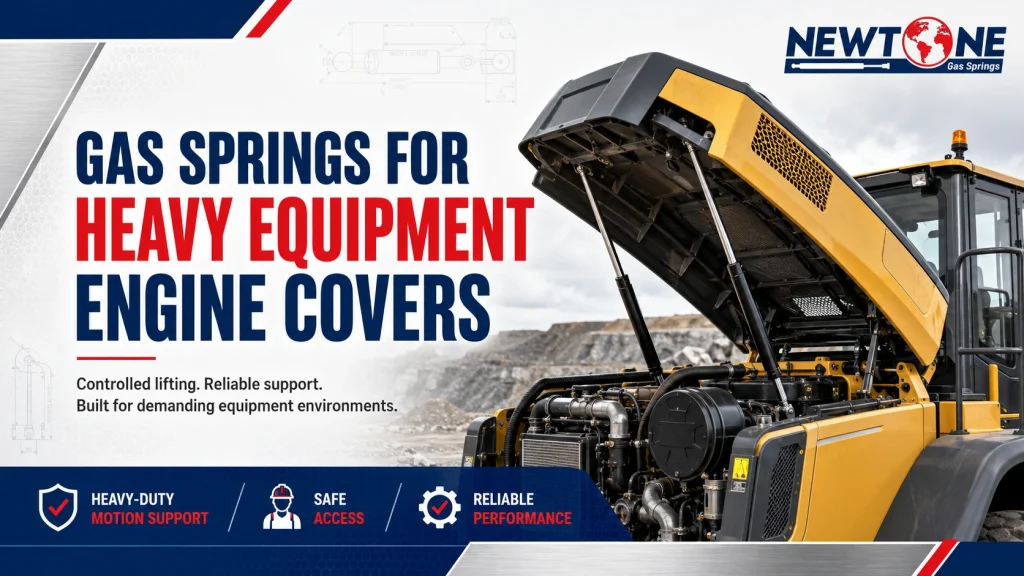
Force, geometry, and heat-soak sizing for excavator, loader, tractor, and genset engine cover struts.
Gas springs for heavy equipment engine covers generally run 300-1,500 N (67-337 lbf) per strut on excavators, wheel loaders, tractors, and genset enclosures — well above the 50-250 N (11-56 lbf) range typical of an automotive hood, because these covers weigh more, sit closer to the hinge relative to their own weight, and have to keep working after the mounting bracket has spent an hour a few inches from the block. The right figure for a given platform comes out of the hinge geometry and a worked moment calculation. A catalog force chart alone will get you close on a passenger car; it won’t get you close on a 30 kg excavator hood.
Picture a mid-size excavator with the engine cover raised for a filter change. The technician needs it to open with one hand, stay open on its own in a light crosswind, and not come down on anyone’s fingers when they close it. That’s the job these springs do, and it’s the same brief whether the buyer is an OEM engineer speccing a new platform, a procurement manager standardizing struts across a mixed fleet, or an aftermarket distributor matching a replacement part for a machine that’s been in service for a decade.
How to Size Gas Springs for Heavy Equipment Engine Covers
The force each strut has to supply is set by the moment balance about the hinge: F = (W × Lg × cos φ) ÷ (n × r). Get the geometry wrong and no amount of “heavy duty” force fixes it — the cover either won’t stay open or it slams.
F = (W × Lg × cos φ) ÷ (n × r)
- W = supported weight of the cover (N)
- Lg = hinge-to-center-of-gravity distance
- φ = load-arm angle above horizontal at the hold-open position
- n = number of springs
- r = perpendicular moment arm of the spring at the mounting point
Worked example — 32 kg (70.5 lb) excavator engine cover, two struts:
W = 32 kg × 9.81 = 313.9 N (70.6 lbf)
Lg = 480 mm (18.9 in), φ = 10° (cos 10° = 0.985), n = 2, r = 65 mm (2.56 in)
F = (313.9 × 0.48 × 0.985) ÷ (2 × 0.065) = 1,141.7 N (256.7 lbf) per spring at a 20°C bench baseline.
Apply a 1.15 safety factor for outdoor, vibration-heavy duty: F_design = 1,141.7 × 1.15 = 1,312.9 N (295.2 lbf), which rounds to a standard 1,300 N (292 lbf) matched pair.
Size for both ends of the thermal swing, not just the cold one
A strut mounted within a few inches of a running diesel block or turbo can see local temperature 40-50°C above the surrounding air, even on a mild day, because the cover traps radiant heat and dust shrouding restricts airflow that a car’s engine bay usually gets for free at highway speed. Most published sizing guidance only warns about cold-weather softening. Heavy equipment engine covers face the opposite problem too, and it matters just as much.
Using the temperature-derating relationship F_T ≈ F_20 × [1 + 0.003 × (T − 20)]: a cold jobsite start at -20°C gives F = 1,141.7 × 0.88 = 1,004.7 N (225.9 lbf) — about 12% softer, which can make a cold cover feel sluggish to lift. After a few hours of heat soak at 70°C at the mounting point, F = 1,141.7 × 1.15 = 1,313 N (295.2 lbf) — roughly the same increase in the other direction, which happens to land close to the design force above. That overlap is exactly why both ends of the swing need checking against the same spec, not just the cold one: undersize for the cold case and the cover won’t hold; ignore the hot case and handling force during closing creeps higher than an operator expects.
Where Gas Springs for Heavy Equipment Engine Covers Are Used
Excavator & Loader Hoods
Top-hinged, wide covers over the engine bay; typically 800-1,500 N (180-337 lbf) per spring in a matched pair, sized for full clearance at open without contacting the cowl.
Tractor & Ag Equipment Covers
Lighter panels than construction equipment in most cases, often 300-700 N (67-157 lbf); chemical and fertilizer exposure is the main material consideration here, not raw force.
Genset & Power Unit Enclosures
Frequent daily cycling for inspection and fueling; cycle life and consistent hold-open force matter more here than peak force.
Forestry & Skidder Covers
Highest dust and impact-debris exposure of the group; seal integrity and rod protection carry as much weight as the force calculation.
The most common spec mistake: one force number, no geometry, no heat check
We saw this play out with an engine cover OEM in the Midwest supplying covers for a new skid-steer platform. Their outgoing supplier had specified strut force the way an automotive-hood catalog does — a single number, sized on a cold bench test — and one of their engineers had asked, in different words, whether it made more sense to shorten the strut or increase the force once the hinge geometry changed on the new frame. When we ran the moment-arm calculation against their actual pivot points, the original force guess turned out to be about 18% too high for the corrected geometry, and the excess force had also been letting the cover overshoot at full open and lightly contact the cowl. Correcting both the force and the mounting distance before tooling fixed the open-and-hold behavior and kept the cover clear.
Single Spring or Paired Springs
Single Spring
Fits small access panels and lighter covers, under roughly 15 kg (33 lb), with a centered center of gravity. One spring, centered on the panel width, is usually enough.
Paired Springs
The default for full engine covers. Two springs mounted one per side share the load and resist the panel twisting under wind or an off-center push. Pull both from the same production batch, matched within ±5% of each other — a mismatched pair lifts unevenly and puts extra wear on one side of the hinge.
Standard Rod vs Stainless Steel for Engine Covers
A black nitrided rod (900-1,000 HV, 20-30 micron) with HNBR seals handles standard dust, mud, and UV exposure without issue, and it’s the right default for most inland construction and general industrial applications. Move to 316L stainless when the equipment runs coastal, marine, or in consistently high humidity, or on agricultural machinery exposed to fertilizer and chemical washdown — chrome-plated rods in that environment tend to pit at the seal line years before the spring’s rated cycle life is used up.
Locking Gas Springs for Maintenance Access
Specify a locking gas spring wherever a technician works underneath or behind a raised engine cover for anything longer than a quick check. A standard spring holds the cover open under normal conditions, but a locking version gives a positive, hands-free hold at full extension so the cover can’t creep down under vibration or a light bump. Release mechanisms should only be specified once the actuation geometry has been qualified for the specific platform — an unintended release under a raised cover is exactly the failure this feature exists to prevent.
Specification Quick Reference
| Parameter | Typical spec for engine covers |
|---|---|
| Force range | 300-1,500 N (67-337 lbf); full manufacturing range 20-7,500 N (4-1,686 lbf) |
| Force tolerance | ±5% |
| Rod treatment | Black nitrided, 900-1,000 HV, 20-30 µm (standard) or 316L stainless (coastal/chemical) |
| Seal standard | HNBR, UV and ozone resistant |
| Temperature range | -40°C to +100°C (-40°F to +212°F) |
| Cycle rating | 100,000+ minimum |
| Configuration | Paired, ±5% same-batch match, for full covers; single spring for small access panels |
| Stroke | Geometry-dependent — engineering support available for platform-specific calculation |
Why Source Engine Cover Gas Springs From Newtone
Manufacturer, Not Distributor
Production facility in Turkey, exporting to 60+ countries, with OEM and aftermarket supply from the same platform.
±5% Force Tolerance
Held consistently across a production batch, which matters most in paired-spring installations.
Geometry-First Engineering Support
Send your hinge dimensions and cover weight; response within 5 business hours.
HNBR Seals as Standard
UV and ozone resistant, rated for outdoor construction and agricultural duty cycles.
FAQ
An engine cover strut is a short list of numbers — force, stroke, tolerance, temperature range — but getting them right takes the actual hinge geometry, not a catalog lookup. Send us the dimensions and we’ll work the calculation with you.